Raj Agrawal

Learnings from software and technology

  • Home
  • Technology
  • Software
  • Work
  • Play

Connect

  • GitHub
  • LinkedIn
  • YouTube

Powered by Genesis

You are here: Home / Archives for Consumer Technology

NFC Technology – Everything You Need To Know

March 1, 2012 by Raj Agrawal 1 Comment

UPCOMING TECHNOLOGY – NFC Technology (Near Field Communication Technology) will bring in the ‘next level’ convenience and sensibility to the way we exchange information. This technology can easily be scaled up to many areas of applicability, which is what makes it another add-on into the list of ‘Next-Big-Things’. Now, lets look at some of the key aspects of NFC Technology including what it is, how it works, NFC in the market place and it’s future.

nfc-technology-bluebite
Image credit – BlueBite

What is NFC?

NFC stands for Near Field Communication and as the name suggests, the key for this technology lies in devices being in close proximity or contact with each other. Once devices have established the proximity, which is enabled very quickly (0.1 sec), the communication is enabled. The distances in terms for NFC must be very small, usually less than an inch and as such it is different from comparable communications like Wi-Fi and Bluetooth for which there are natural comparisons.

How NFC Technology works

Near field Communication operates through short wave radio transmission. Devices that operate NFC technology like smartphones or PDAs, are equipped with an NFC chip. The process of communication between the chip in one device and the chip in another device is an electronic process called inductive coupling. This coupling is a development of an earlier technology, Radio Frequency Identification (RFID). With RFID, the technology had a ‘send and receive’ process and was used in a one directional format. NFC takes this process to the next level and allows two way communication between NFC Technology enabled devices.

NFC in the Marketplace

The current scope of NFC services is in its infancy in terms of market launch and proliferation. The global range of the product is sporadic and there are a variety of test locations which have embraced this technology, the key markets of USA and Japan are showing a steadily growing rise in the number of transactions as the technology takes hold. In recent surveys, a growing number of people have stated that they would much rather pay using their phone than carry cash. The scope is of demand is being trialled in some key market areas in Europe and Asia with a growing body of evidence revealing general product in performance in France, South Korea, Turkey, United Kingdom and Tanzania.

France offers the earliest evidence of information with NFC technology in operation, during the early May 2010. There, NFC has been used for purchases of civil services like transportation information and ticketing, similar services have been used for the system in South Korea from later in that same year. More recent progress of the technology can be seen in Turkey where, from early 2011 in Turkey up to 55,000 separate retail processes could be operated using the system. A more limited facility (15,000 outlets) mainly through banks and mobile phone companies has been in evidence in the UK through 2011 and Tanzania.

The statistical data on the number of Near Field Communication transactions globally illustrates a growing trend for usage, but one which is only at the tip of the iceberg if general predictions are to be believed. According to statistics released by Juniper Research Visa has issued 20,000,000 NFC enabled cards and Google Wallet can currently operate at 311,000 locations globally. Predictions for the number of transactions to be made using NFC devices over the coming couple of years show a sharp increase to a plausible 50,000,000 global transactions by 2014. The bulk of these will occur in Europe, US and Asia.

Brands already incorporating NFC

It is also estimated the more than 1/10th of the smart phones sold globally were NFC ready devices with many of the major brands including Blackberry, Nokia, Google and Samsung employing the technology in a range of their handsets. In addition to the handsets. the technology is a part of MasterCard and it can even be found in the Wii controller. Although this claim is yet to be verified, it is rumoured that Apple has come on board and has planned to have NFC as part of iPhone 5 and iPad 3.

Emerging markets

The growth of NFC technology is not limited to developed markets either with the rise in usage occurring in a number of emerging markets. A recent report for Financial Firm Citigroup stated that there were,

40 million mobile money users exist in Africa – the lion’s share of this is attributable to the over 20 million users of Safaricom’s M-Pesa offering in Kenya.

A further report by Communications Commission of Kenya highlighted this growing trend,

The continued growth is an indication of subscribers’ preference to mobile money transfer, which could be attributed to accessibility and affordability even to low-income earners who form the bulk of the unbanked population.

The Future of NFC

Near Field Communication is here and set to be the next big thing. Watch out for stores in your locality promoting the use of paying by handset. With key players like Google and Apple preparing themselves for this market, it is inevitable that the NFC Technology (with the era beginning with NFC Phones) will become a part of our society.
Filed Under: Consumer Technology Tagged With: apple, google, nfc, samsung

Audio Technica CKP300 Hands-On Review

February 16, 2012 by Raj Agrawal Leave a Comment

Audio Technica CKP300 (ATH CKP300) is a sports series in-ear headphone, which comes from a brand known for it’s high quality audio products. Audio Technica CKP300 is specifically designed for portability and compatibility with different portable audio devices available. I bought them and thought a hands-on review might help you guys decide, in case you are looking for a new pair!

Build Quality

Audio Technica CKP300 being sport series earphones have a good build quality. The cord is rubberized and will not get tangled easily because of the new bended bushing design. The earphones are drip proof/moisture resistant(IPX2 cleared by JIS/IEC). The earphones have 3.5mm connectors which are compatible with most of the portable devices. Both the extension cord and the earphone have gold plated connectors for high audio quality. The earphones have an I-shaped connector while the extension cord has a L-shaped connector.

Sound

At a price of about INR 1,800 you expect good audio quality and the CKP300 doesn’t disappoint. Even though these earphones cover a wide range of frequencies (5 ~ 22,000Hz), these are more focused on the mids and highs. The 10.7 mm driver delivers clear sound. The separation is good on these earphones, different instruments can be heard clearly. The soundstage is OK considering these are In-ear monitors. I wouldn’t call these bassy earphones, not that the bass output from these earphones is low, these earphones do provide good amount of bass, but rap & hip-hop listeners may find it to be on the lower side. These are fairly bright earphones more suited for rock, classical music. These earphones provide good isolation even in noisy surroundings. The impedance of these earphones is 16 ohms which makes them easy to drive, but it may cause some noise to creep in.

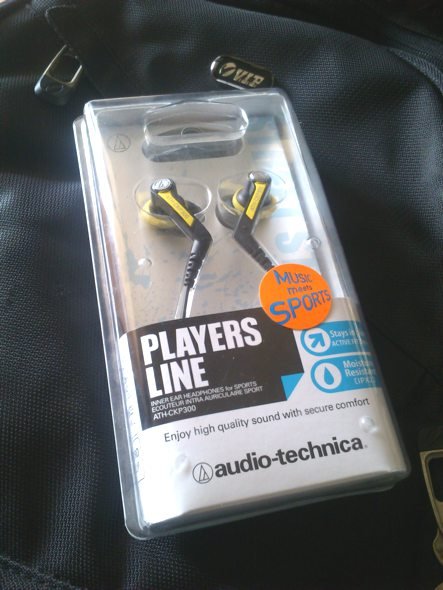
ATH CKP300
ATH CKP300 (Front)
ATH CKP300
ATH CKP300 (Side)

What’s In The Box

  • Earphones
  • Extension cable
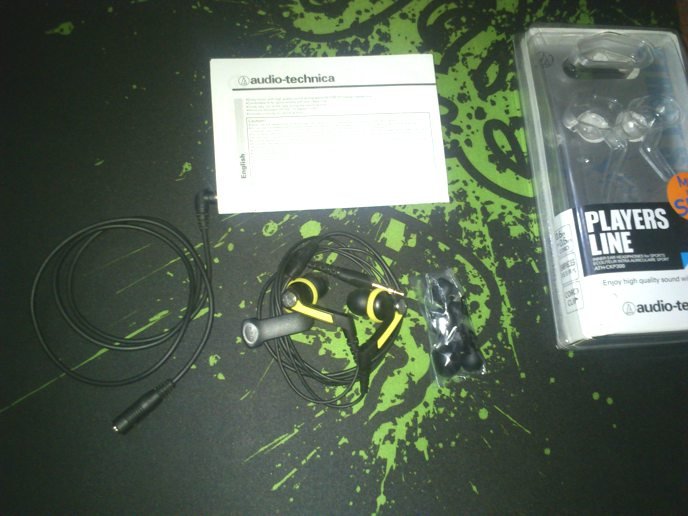
  • Silicone tips
  • Information booklet
ATH CKP300
ATH CKP300 (Kit)

The earphones come in a well packaged box, which is easy to open unlike some other earphone boxes where you have to use a knife or scissors. The box has a transparent top trough which you see the earphone’s tips. Inside the box you will find an Instruction booklet (in 8 languages), extra silicone tips, an extension cord & the earphones.

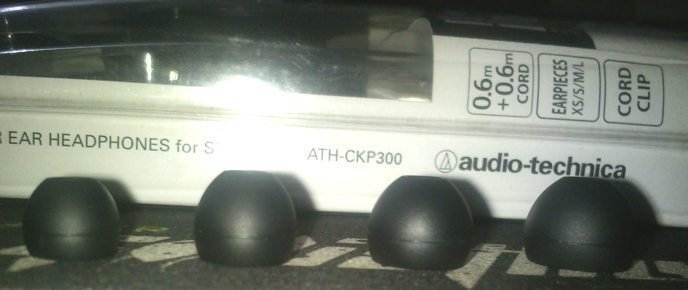
Audio technica provides with four sets of tips with these earphones extra small, small, medium & large.

The earphone’s cord is 0.6m long, they have also included 0.6m long extension cable if the earphone’s cord is too short for some devices.

Conclusion

For their price these do provide a bang for the buck. They have good build quality, clear sound, drip proof. Apart from the short earphone cord and slightly low bass, these are worth buying!

Tech Specs

  • Product Name – ATH-CKP330
  • Driver – 10.7mm
  • Output Sound – 105dB/mW
  • Frequency Response – 5 –  22,000Hz
  • Max Input Power – 100mW
  • Impedance  – 16
  • Weight – Approximetely 7g
  • Plug – ø3.5mm Gold Plated Stereo Mini Plug
Availability – Yes
Price – ₹ 1,800

Filed Under: Consumer Technology

3D Printing Technology Steps A Level Ahead In 2012

February 6, 2012 by Raj Agrawal 6 Comments

With the beginning of 2012, 3D printing technology has stepped a level above. Believe it or not, 3D Printing Technology has existed since a really long time. Charles Hull invented the first 3D printing method – Stereolithography, in the year 1986. And since then, many other 3D printing methods have plunged into the commercial market; each of them featuring different layer building patterns.

the replicator
The Replicator by Makerbot Industries.

For now, 3D printing has been more tilted towards building moulds/ prototypes for industrial applications and several other places. Even Dental labs are using 3D printing to help fabricate crowns and bridgework. These devices have been expensive enough to ‘not’ cater the domestic/ desktop category. But, there have been a handful of services to bridge this gap and allow anyone to send digital prints and get them moulded exactly into plastic, metal, ceramic or even food art. So for domestic usage, this is how far 3D printing goes for now.

The only limiting factor is our imagination

The statement may sound clichéd, but in 3D printing technology’s case, it’s just right. The application and scope of 3D printing technology is much wider than what most of us can perceive. When this technology scales to a much wider applicability, the results will drastically improve our living. Quite recently, Artificial blood vessels have been created with 3D Printers and it may soon have its place for transplants of lab created organs. Now think about that. 3D printing does not only pertain to materialistic objects, it can even work with human physiology.

So moving back to our discussion on 3D printing technology in domestic/ desktop category, this year in 2012, more companies are coming up with services and devices to target the desktop users and make the 3D printing devices more accessible and even affordable.

Cubify.com provides a Kinect-To-Print app where you can make designs with color book simplicity and get them delivered at your place.

Consider an Open Source initiative, RepRap.

It’s 3D printer and a variant of fused deposition modeling which can print most of it’s own components. Due to this self replicating nature, it can be made cheaply distributed and aid the users in printing their own creations. It’s also one of the first low-cost 3D printers.

This video talks about RepRap

The MakerBot Replicator

It is an affordable, DIY, open source 3D printer, compact enough to sit on a desktop. With this, you to print objects in color, upto the size of a bread loaf. It’s decently priced under $2,000, i.e less than र 1 lakh.

Bre Pettis, founder of Makerbot talks about The Replicator

As we can see, newer 3D printing methodologies and products are gradually hitting the mainstream market. Though there is a lot more to be seen and improved to make 3D printing a magnificent tool than it already is. It will strafe us forward to more practical applications and build almost everything with utmost precision, quality, ease and of course, at much cheaper costs of production.

Filed Under: Consumer Technology Tagged With: open source

  • « Previous Page
  • 1
  • …
  • 6
  • 7
  • 8
  • 9
  • 10
  • …
  • 25
  • Next Page »